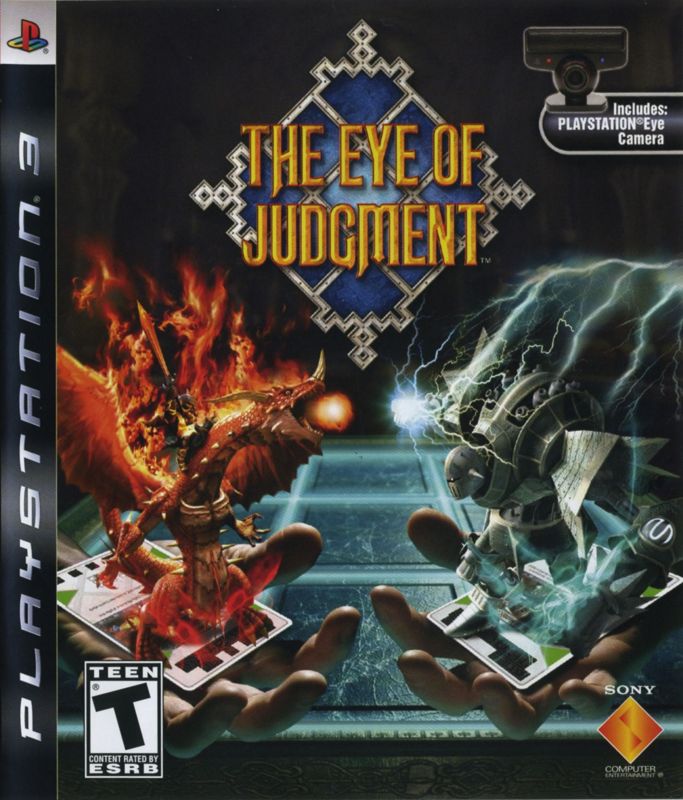
Eye of Judgment is a turn-based card battle game that utilizes the PlayStation Eye camera peripheral and a 3x3 rectangular table mat with real trading cards. The camera not only recognizes the cards, but also their position and rotation on the mat. This represents a battlefield where players can summon creatures and cast spells. The story takes place in a fictional world shaped by The Source, where humanity's pursuit of power led to the construction of Bioliths, devices meant to help defeat the gods. After a long war, Jeano, the son of The Source, turns all the Bioliths to rust. Eventually, four sages found four different nations: fire, water, earth, and wood, ushering in a time of peace. However, a mechanical fortress appears in the sky, and the Biolith surprise attack wipes out three of the four nations. The remaining nation, wood, receives a message to send a lone wizard to Cape Edgeworth with a single chance to defeat the Biolith Castle.
The game can be played through single-player mode (with an adventure path and various opponents), head-to-head modes, or online multiplayer. Using the camera, players track movement and creatures seem to come to life on the screen. Each turn allows players to move, rotate, or change a card's position. The abilities of cards change according to their placement, with face-up cards summoning creatures. While attacking, the screen shifts to battle mode, where spells can be used.
The center area is always Biolith, while the other areas are randomly divided among the four elements, affecting creature abilities and providing bonuses or weaknesses. Actions are performed through mana, received at the beginning of a turn or from certain cards. The first player to capture five areas of the field wins.
One of the game's unique features is its camera tricks, such as profile mode, where players can hold a card in front of the camera to view information and interact with creatures.
The base game includes 30 summoning cards and four function cards, along with a booster pack containing eight additional summoning cards (five common, two uncommon, one rare or ultra-rare). Additional packs can be purchased separately.




_1.png)
.png)


_1.jpg)