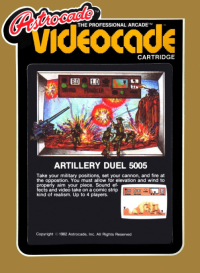
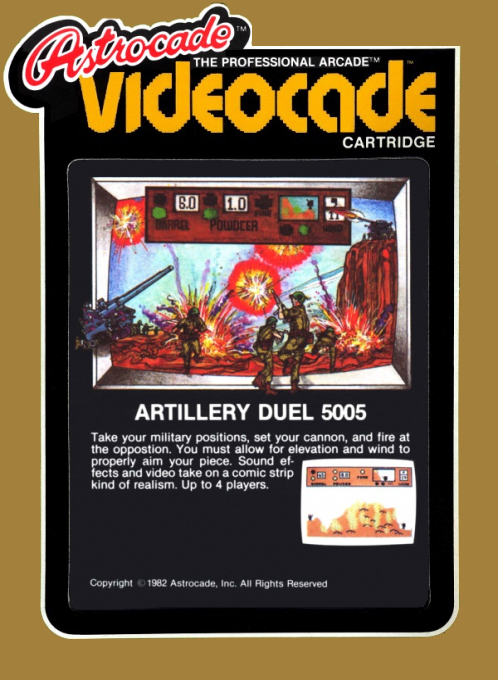
In the 1982 game Artillery Duel and its various ports and compilations, players control opposing artillery pieces positioned on mountainous terrain. Players adjust the angle and powder charge of their cannons to destroy the opposing artillery unit before being destroyed themselves. The characters are depicted as military cannons operated by unseen or minimally animated soldiers.
Originally programmed by Hugo Rodriguez for the Bally Astrocade in 1980, the game and its signature artillery units gained widespread recognition through the 1982 Atari 2600 port of
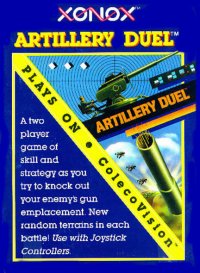
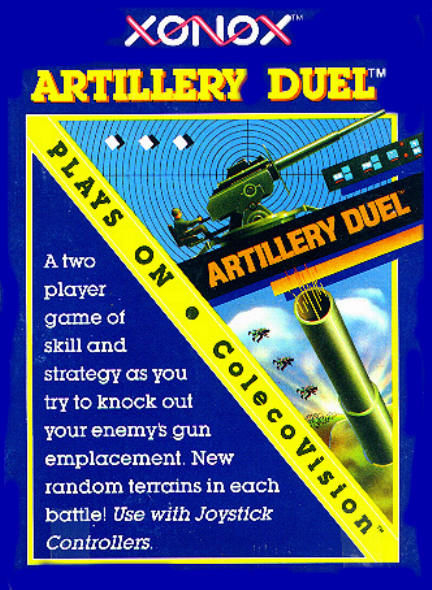
Artillery Duel published by Xonox. This release established the visual identity of the opposing red and blue artillery pieces. Xonox heavily promoted these characters through unique marketing strategies, most notably packaging the game on "Double-Ender" cartridges. These dual-game cartridges paired the title with other releases, resulting in compilations such as
Artillery Duel & Chuck Norris Superkicks (1983) and
Artillery Duel/Ghost Manor (1983) for the Atari 2600, Commodore 64, and ColecoVision.
Subsequent 1983 ports of
Artillery Duel for the VIC-20 and Texas Instruments TI-99/4A maintained the core design of the artillery units while adapting the graphical fidelity of the terrain and explosion animations to match each system's capabilities. The character design of these stationary, turn-based combatants influenced the aesthetic of later artillery games. By presenting the artillery pieces as distinct, color-coded entities with individual scoreboards, the franchise helped transition the classic mainframe "artillery game" genre into a commercially viable console product with recognizable, recurring character assets.

.png)


.png)


_1.png)

.png)
.png)
_1.png)