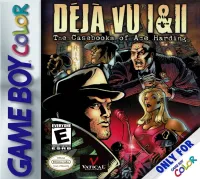
The Deja Vu series began with Deja Vu: A Nightmare Comes True (1985, with ports in 1987, 1988, 1990, and 1991) and was followed by the sequel Deja Vu II: Lost in Las Vegas (1988, with ports in 1989 and 1991). Players control private investigator Theodore 'Ace' Harding as he solves mysteries in a noir-style setting. The games were part of ICOM's MacVenture series, utilizing a pioneering graphical point-and-click interface.
The franchise expanded across multiple home computers and consoles, receiving distinct adaptations. Following its initial computer release,
Deja Vu: A Nightmare Comes True (1987) arrived on the Nintendo Entertainment System, featuring a rearranged chiptune soundtrack by Kemco. Concurrently,
Deja Vu (1987) and
Deja Vu (1988) were ported to platforms like the Amiga, Atari ST, and Apple IIGS, which showcased detailed color graphics and mouse-driven navigation.
The narrative continued with
Deja Vu II: Lost In Las Vegas (1988), which tasked players with escaping a debtor's prison and navigating the desert. This sequel saw wider distribution through
Deja Vu II: Lost In Las Vegas (1989) on personal computers. Later,
Deja Vu (1990) and
Deja Vu (1991) brought the original mystery to additional international markets and handhelds, while
Deja Vu II: Lost in Las Vegas (1991) finalized the series' initial run on home computers. These releases are noted for their unforgiving difficulty, where incorrect choices, such as consuming unidentified pills or failing to pay a cab fare, result in immediate failure. The series remains a milestone in the evolution of graphic adventure design.