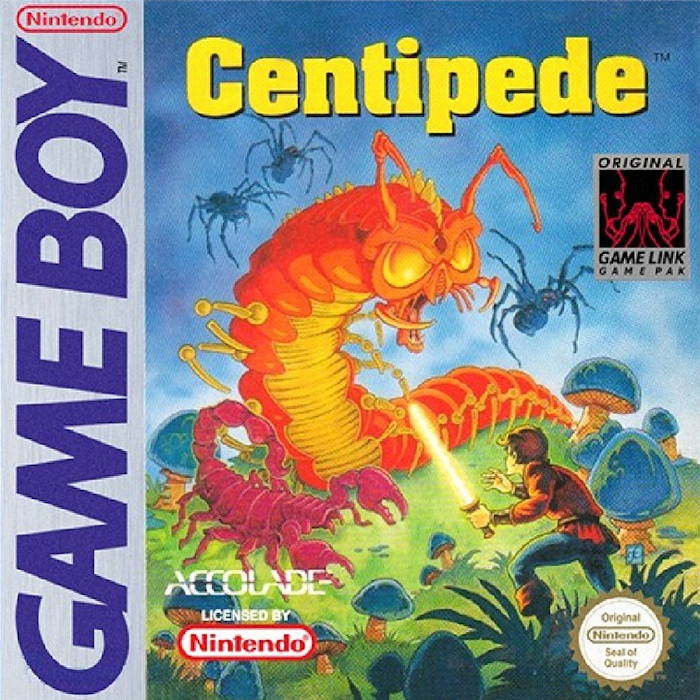
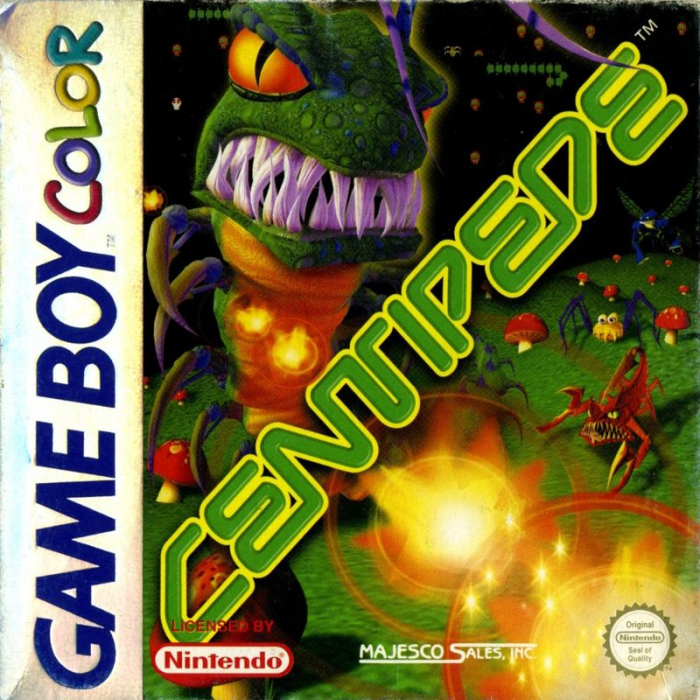
In the Arcade Classic franchise games Centipede (1992), Arcade Classic 2: Centipede and Millipede (1995), and Centipede (1998), Poison Mushrooms are created when a scorpion runs across a standard mushroom. When a centipede segment collides with a Poison Mushroom, it immediately dives straight down toward the player's shooter. Players must destroy these distinctively colored obstacles to prevent the centipede from rapidly invading the player area.
Originating from the foundational design of the classic arcade era, these hazardous obstacles transitioned to home consoles and handhelds through key releases. In the Game Boy version of
Centipede (1992), the limited screen resolution and monochrome display required distinct sprite detailing to differentiate them from standard mushrooms. The compilation
Arcade Classic 2: Centipede and Millipede (1995) for the Super Nintendo Entertainment System preserved the original arcade color-cycling behavior, rendering them in a flashing palette to warn players of the impending danger.
With the release of the 3D remake
Centipede (1998) on PlayStation and PC, the obstacle transitioned into three-dimensional space, featuring updated polygonal models while maintaining the core mechanical behavior established in the 1980s. Across these titles, successfully destroying a poisoned target awards the player 100 points, double the value of a standard mushroom. This scoring incentive, combined with the tactical necessity of clearing vertical pathways, makes managing these corrupted obstacles a central focus of high-score strategies in the franchise.
 (SGB Enhanced).png)



 (SGB Enhanced).png)