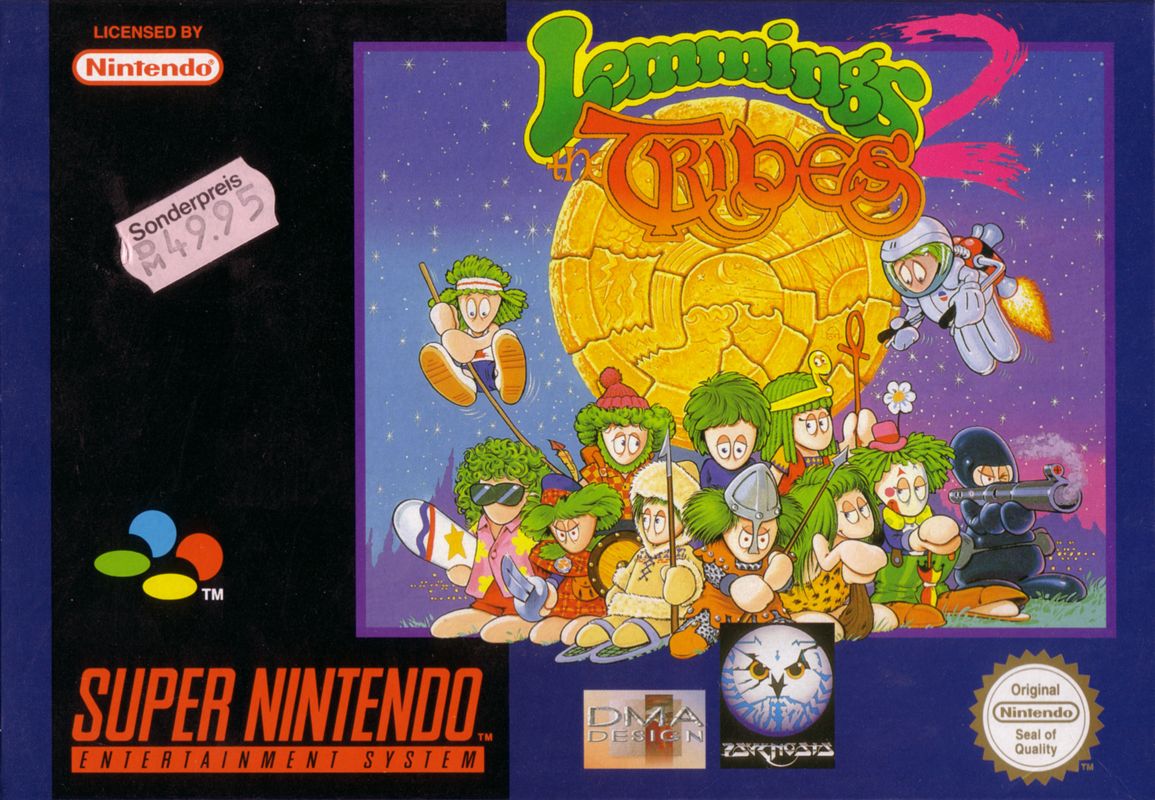
In games like Dig Dug and Lode Runner: The Legend Returns, the exit serves as the final destination once level objectives are completed. In Super 3D Noah's Ark and Lemmings 2: The Tribes, guiding characters or the player to the exit is the primary goal of each stage. Within Zone of the Enders, exits function as tactical boundaries or escape vectors during combat missions.
The mechanical evolution of these exit points reflects shifting design philosophies across the
Dig Dug and
Zone of the Enders franchises. In the 1992 emulation and port cycle of
Dig Dug, the exit manifested as a physical escape route when only one enemy remained, penalizing players who lingered too long. By 1994,
Super 3D Noah's Ark utilized secret exit locations to reward thorough exploration, hiding bonus levels behind disguised walls. That same year,
Lemmings 2: The Tribes expanded the concept by styling exits to match the aesthetic of twelve distinct tribes, ranging from medieval castles to futuristic warp zones.
In
Lode Runner: The Legend Returns (1998), the exit took the form of a subterranean portal that dynamically materialized, often requiring precise timing to reach before hostile monks blocked the path.
Zone of the Enders (2001) integrated the exit into its radar HUD, transforming it into a spatial mechanic where crossing the boundary saved civilian structures from collateral damage.
Qix Neo (2003) adapted this by linking the exit trigger directly to percentage-based territory capture, instantly transitioning the player upon reaching the threshold.
.png)
_1.jpg)
.png)
 (Unl).png)


_1.jpg)

.png)



 (Unl).png)
.png)