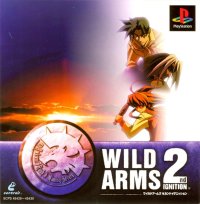
The Wild Arms series debuted with the self-titled Wild Arms in 1996 (released in North America in 1997), followed by its sequel Wild Arms 2 in 1999. Developed by Media.Vision, the franchise is known for blending traditional fantasy elements with Western motifs and technology, accompanied by strategy guides from publishers like Versus Books, Prima, and Dimension Publishing.
Set on the decaying world of Filgaia, the franchise distinguishes itself through its unique puzzle-focused dungeon exploration. Players utilize character-specific "Tools"—such as bombs, grappling hooks, and wind-up toys—to navigate environments and solve environmental hazards. The combat system relies on turn-based encounters, utilizing a "Force Area" meter that builds during battle to unleash powerful guardian summons and special abilities. Composer Michiko Naruke established the series' auditory identity, incorporating whistling, acoustic guitars, and brass instruments reminiscent of classic American Western cinema.
Following the initial success of
Wild Arms (1996) in Japan, Sony Computer Entertainment published the game internationally as
Wild Arms (1997) in North America and
Wild Arms (1998) in Europe. Its popularity in domestic markets earned it a budget reissue under the
Wild Arms PlayStation the Best] (1996) label. The intricate dungeon designs and hidden secrets of these early entries generated a demand for detailed player resources, resulting in dedicated publications like the [Wild Arms Prima] (1997) guide and the [Wild Arms Dimension Publishing] (1999) guide. The subsequent release of [Wild Arms 2 (1999) introduced a dual-scenario narrative structure, supported by the
Wild Arms 2 [Versus Books] guide to assist players with its expanded roster and complex mechanics.