THE STORY
Collapse of the Han Dynasty
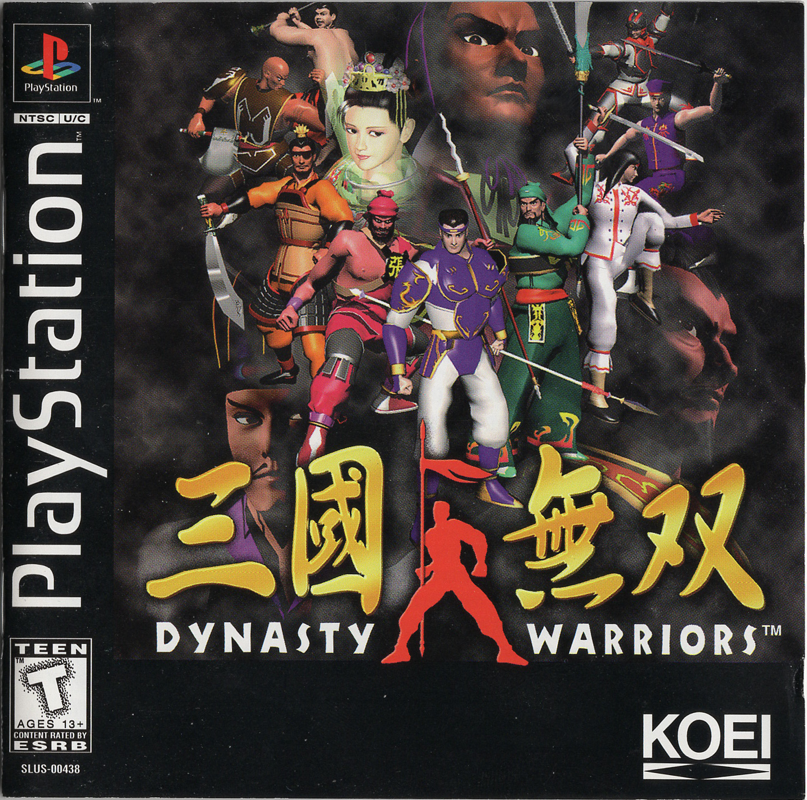
The events told here are from China 1,800 years ago. Two hundred years after the Emperor Guang-Wu revives the Han Dynasty, war and chaos once again ensue. Despotic rulers, scheming eunuchs and bureaucratic infighting wreck the Eastern Han Dynasty. One violent faction, the dreaded Yellow Turban Rebels, roam the country removing officials by force.
During this chaotic time, an urgent order is sent to nobles to raise troops and defend Emperor Shao. Dong Zhuo, an ambitious and opportunistic warlord, defeats the rebel disturbance and takes the capital of Loyang. He declares himself Prime Minister and begins a tyrannical campaign to rule the country.
Many prominent nobles are alarmed by this turn of events. Together they form a league against Dong Zhuo, and pledge to overthrow him. At the same time, they individually strive to establish their own kingdom as the strongest in hope to unite the people under a new dynasty. For the next 100 years, China is torn apart by marauding warlords and warriors who seek to leave their mark on history. Warriors of The Three Kingdoms
Three men gain regional supremacy by the early third century - Cao Cao in Wei, Sun Quan in Wu, and Liu Bei in Shu. They are aided by warriors who disdain defeat-heroes who single-handedly challenge enemy forces to uphold the honor of their lord. When these fighting men meet, hardened by a hundred battles, only one can become "Musou - The Warrior Unequaled." HISTORICAL BATTLE SITES
HU LAO GATE (TIGER TRAP GATE)
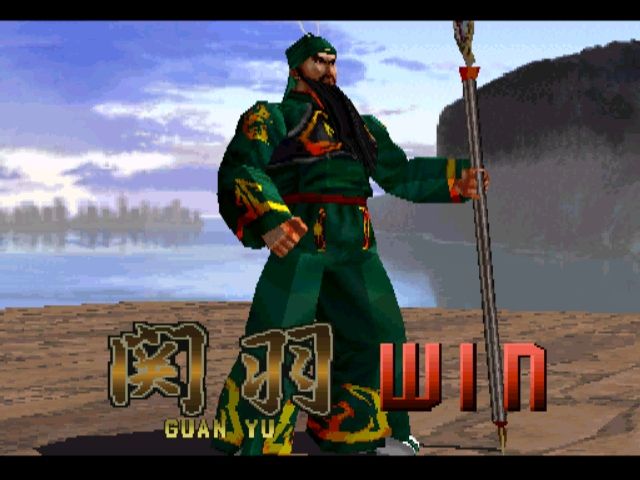
Dong Zhuo stationed his warriors here to protect the capital city of Loyang from warlords in the east. When the anti-Dong Zhuo League of 18 warlords attacked this narrow pass, Hua Xiong challenged and slew many of the worthy opponents. Amidst feelings of desperation, an unknown mounted archer proclaimed, "I offer to present Hua Xiong's head to you personally!" "Who is this man?" demanded the head of the League. "If I fail, my head is yours" replied Guan Yu.
Cao Cao heated a draft of wine for Guan Yu before he mounted. "Pour it," said Guan Yu, "and set it aside for me. I'll be back shortly." Guan Yu returned and tossed Hua Xiong's freshly severed head to the ground. An astounded general uttered, "Before the wine had time to cool, Hua Xiong lay in the dust!"
After Hua Xiong's death, Dong Zhuo placed his best warrior, Lu Bu, and 150,000 men to defend the gate. Lu Bu single-handedly met the opposition of Guan Yu, Zhang Fei and Liu Bei, but after endless challenges, he fled. This was the first major victory for the three sworn brothers.
PHOENIX PALACE
The Phoenix Palace was Dong Zhuo's palatial residence and the center stage for Diao Chan's plot to destroy the tyrant ruler. By double-pledging her love to both Dong Zhuo and his adopted son, Lu Bu, she manipulated their affection until jealousy drove them apart.
Diao Chan pleaded to Dong Zhuo that she would rather take her own life than marry the beast of Lu Bu. However, in a secret meeting with Lu Bu, she also feigned to commit suicide to prove her love, crying "Since I can never be your wife in this world I want to arrange to meet you in the next!" This convinced Lu Bu to murder Dong Zhuo.
GREAT HALL, SHANG YANG
In 196 A.D., after Dong Zhuo destroyed and fled Loyang, Cao Cao took protection of Emperor Xian and opened a new capital in Shang Yang. It later became the capital of the Wei Kingdom in 202 A.D.
GUAN DU
Here in 200 A.D., Cao Cao battled his former anti-Dong Zhuo ally and long-term rival, Yuan Shao. Although Cao Cao had only one-tenth of Yuan Shao's army, he seized victory with cunning tactics and the help of Guan Yu, who was captured in a previous battle.
This battle was indeed a turning point for Cao Cao; gaining control of vast central China, he secured the country's most strategic position and almost two thirds of the land. From there, he went on to established the Wei Kingdom.
CHANG BAN
In 208 A.D., Liu Bei was forced to abandon his infant son during his retreat from Cao Cao. Alone on horseback, Zhao Yun rescued Liu Bei's son from the midst of the enemy army, leaving more than fifty warriors dead in his wake.
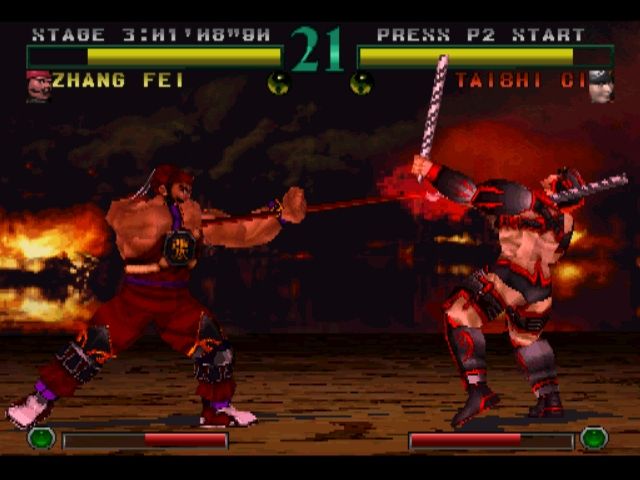
Upon Zhao Yun's triumphant return, Liu Bei cried out, "Too great the risk you ran to save this child! I very nearly lost a great captain!" Zhao Yun wept and replied "Were I ground to powder, I could not prove my gratitude." Zhang Fei then instilled fear in the hearts of Cao Cao's armies with a great roar of defiance, and destroyed the Chang Ban bridge after they crossed to safety.
RED WALL
Following the victory over Liu Bei, Cao Cao challenged Sun Quan to surrender his rule in southern China. Persuaded by Liu Bei's advisor, Zhuge Liang, Sun Quan decided to ally with Liu Bei to thwart Cao Cao's ambition to conquer China.
In 208 A.D., during the naval battle of Red Wall, Sun Quan's commander, Zhou Yu, employed brilliant intelligence tactics and planted spies in the famous Chain Link scheme. While an allied ship feigned surrender to set Cao Cao's linked ships ablaze, Zhuge Liang summoned the southeastern wind to
.png)

.png)






.png)




_1.png)
_1.png)
_1.png)
.png)