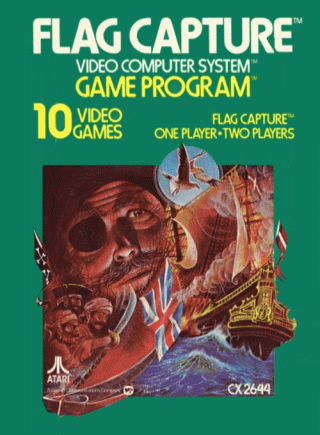
Emerson Radio Corp. entered the video game market with the release of the Arcadia 2001 console in 1982. The company is associated with early titles such as Capture (1980), which was also released as Capture under Sears Tele-Games branding in 1978, and its hardware legacy continues to receive support through modern homebrew releases like Pleiades (2014).
The development of
Capture represented a shift toward intellectual, turn-based strategy games on early home consoles, contrasting with the action-heavy arcade ports of the era. Players engaged in a grid-based territorial battle, a formula that Emerson utilized to demonstrate the system's capability to handle complex board game logic and clean sprite rendering. The distribution partnership with Sears for the
Capture Tele-Games version expanded the reach of Emerson's software design to a broader consumer base during the dedicated console boom.
Decades after the original hardware cycle ended, the technical architecture of these early systems became a focal point for independent programmers. The creation of
Pleiades served as a technical milestone, pushing the restricted video chip and audio capabilities far beyond what commercial developers achieved in the early 1980s. By translating the fast-paced, multi-stage alien assaults of the arcade original into this homebrew format, developers proved the enduring viability of the platform's unique hardware layout. Today, these historical and modern titles form a cohesive timeline of software evolution, kept alive through emulation and physical cartridge runs for dedicated collectors.
Emerson Radio & Phonograph Corp.