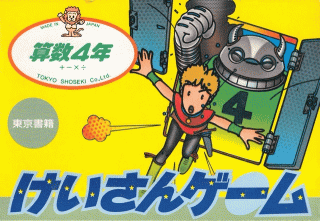
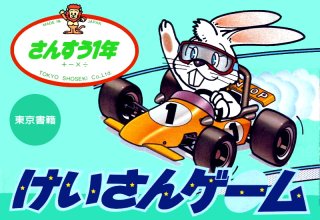
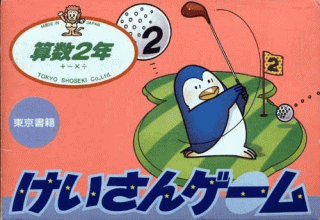
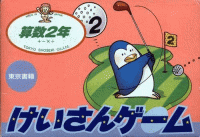
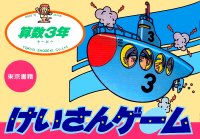
Tokyo Shoseki is a major Japanese textbook publisher that ventured into video game development in the 1980s. The company is best known in the gaming industry for developing the Keisan Game series in 1986, which includes Keisan Game: Sansuu 1 Nen through Sansuu 5-6 Nen. These educational Famicom titles combined elementary mathematics curriculum with arcade-style gameplay.
To teach arithmetic, these Famicom releases utilized distinct arcade genres tailored to different school grade levels. In
Keisan Game: Sansuu 1 Nen, players solved basic addition and subtraction problems to control a racing car.
Keisan Game: Sansuu 2 Nen and
Keisan Game: Sansuu 3 Nen increased the mathematical complexity, incorporating multiplication and division into desert-exploration and pitfall-dodging action sequences. For older students,
Keisan Game: Sansuu 4 Nen and
Keisan Game: Sansuu 5-6 Nen introduced multi-digit calculations, decimals, and fractions, embedding these challenges within sci-fi space shooters and obstacle-filled robot stages.
By aligning each cartridge with the official Japanese elementary school curriculum, the developer ensured that the digital exercises mirrored classroom progression. This structured approach allowed parents to view the console as a viable study aid rather than a mere distraction. Although the developer later produced other software, this specific five-part mathematics suite established a foundational template for console-based edutainment, demonstrating how traditional pedagogical design could be successfully adapted into interactive, sprite-based entertainment.