In retro video games, this setting is frequently used to explore both historical military campaigns and mythological quests. Titles like Phelios and Gods draw heavily from Greek mythology, while strategy games such as Centurion: Defender of Rome and Warrior of Rome focus on historical empire-building and warfare.
The adoption of Greco-Roman themes in early video games allowed developers to leverage well-known cultural narratives while working within the graphical limitations of 8-bit and 16-bit hardware.
Courageous Perseus (1985) stands as an early Japanese home computer release, pioneering the depiction of Mediterranean legends in an active role-playing format. Namco's
Phelios (1990) translated these aesthetics into a vertical-scrolling shoot 'em up, utilizing scaling effects to depict legendary beasts. On personal computers,
Centurion: Defender of Rome (1991) introduced players to turn-based province management alongside real-time tactical battles and chariot racing. Similarly, the Sega Genesis titles
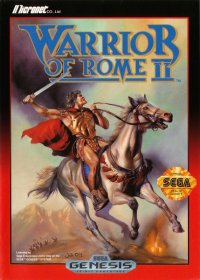
Warrior of Rome (1991) and
Warrior of Rome II (1992) offered real-time strategy simulations focused on naval and land deployments in the Mediterranean theater. The Bitmap Brothers'
Gods (1992) utilized a highly detailed, metallic art style for its platforming challenges, emphasizing lever-based puzzles and precise combat.
These early software designs demonstrated how classical architecture, armor, and literature could be adapted into diverse gameplay mechanics, laying the groundwork for the cinematic historical epics of subsequent console generations.































.png)