STARTING THE GAME
Do not insert or remove peripherals while the Console is turned On.
•
Set up your PlayStation® Game Console according to the instructions in the instruction manual. Make sure the power is off before inserting or removing a Disc. •
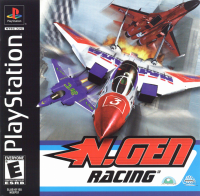
Insert the NGEN Racing™ disc and close the Disc Cover. •
Insert a Controller into Controller port 1. For two players, insert a Controller into Controller port 2 as well. Turn on the PlayStation® Game Console. •
You may skip the introduction sequence by pressing the button.
STANDARD CONTROLS
Do not insert or remove peripherals or MEMORY CARDS once the power is turned on.
NGEN Racing requires 1 MEMORY CARD block to save the game details (only MEMORY CARD slot 1 is supported). If your MEMORY CARD does not have a free block, you will not be able to save your game. To create a free block on a full MEMORY CARD, you should erase any unnecessary data using the PlayStation internal MEMORY CARD manager as outlined in the PlayStation instruction manual. Controls can be reconfigured in the Option Menu. THE MAIN MENU
You should complete the "Basic Controls" tutorial before attempting to fly your aircraft, particularly in Pro Handling.
BRIEFING
There are two flight briefings. Each briefing follows the same principles. First, a control or maneuver is demonstrated, then you have the option to practice the maneuver, review the demonstration, or advance on to the next section.
There is no compulsory examination in briefing mode. However, practice is the only way to become proficient at NGEN Racing. STANDARD RACE ELEMENTS
In all flight modes, your altitude dictates engine efficiency. The lower you fly, the faster you go.
In general, races consist of a qualifying lap followed by a single race (or series of races) against 5 opponents. The race starts with a "rolling" start.
In all modes except Free Flight and Powerball, the pilots fly around circuits which are marked by two sets of parallel strobing lights. Throughout the circuits are a series of checkpoints that the planes must fly through in order.
The pilot will be yellow-flagged if he misses one checkpoint. If he misses another checkpoint after receiving a yellow flag, he will receive a red flag and be disqualified from the race.
Note: In Permits and Majic-12, you are not allowed to miss any checkpoints!
If, during the race, any jets fly out of bounds for longer than the regulated time limit, the auto-pilot will automatically take control and put the plane back on course.
The number of laps in a race varies depending on aircraft class (3 for trainer class, 5 for fighter, 7 for s-fighter and 9 for x-fighter). At the end of a race, the auto-pilot takes control once more and guides the jets back to their hangars.
AIRCRAFT HANDLING
There are 2 different control methods available in NGEN Racing - Arcade and Pro. Note: To fully experience the thrill of jet racing, you should learn Pro handling (use the Practice Mode in Flight Briefing to help you). ARCADE HANDLING
In this mode, the auto-pilot takes greater control of the aircraft, making it easier, though less exciting, to fly. The plane cannot roll right over or loop.
Also, the auto-pilot corrects for roll angle, pitch angle, and altitude whenever the directional controls are released. In addition, fly-by-wire controls translate the player's pitch commands to all control surfaces so that dive and climb always work in relation to the horizon rather than to the angle of the aircraft.
Note: Arcade Handling is slightly slower than Pro Handling.
PRO HANDLING
In this mode, the player has full control over the aircraft. This takes greater skill and practice but is ultimately more satisfying. The Directional Button alters the roll and pitch of the aircraft with no auto-pilot restriction.
CONTROLLING THE AIRCRAFT USING PRO HANDLING
The three axes of rotation needed to control an aircraft are Roll, Pitch, and Yaw. This means banking the aircraft (left & right), making it climb and dive (go up & down), and turning the aircraft without roll.
Rolling the aircraft to the right means that the plane will turn to the right, and rolling left will turn left. Increasing the amount of roll will increase the turning-rate until the aircraft is on its side at 90 degrees to the ground. At this orientation, the aircraft is at its maximum "natural turn-rate".
Once you are heading in the desired direction, returning the plane to level flight will allow you to continue in a straight line. Consequently, unlike a car, even though you may be pressing left, you will not turn left until you go beyond the point of level flight into a left banking position. If you continue to hold left, you will eventually roll the aircraft until it is upside down. Judging corners ahead of you and the required angles of roll to negotiate them can take a fair amount of practice.
Pitch controls the amount of climb or dive the aircraft will perform, so in level flight, you can negotiate the terrain ahead of you. Like an aircraft joystick, the pilot must "pull" backwards on the stick to get the aircraft to go up, and to make it dive, he must "push" the stick away from himself. On the directional control, this is interpreted in the same manner. Pressing "DOWN" will "pull" the nose up, and pressing "UP" will make the nose go down.
However, because this "cl
.png)

.png)



.png)

.png)