Console Setup
Set up your PlayStation® game console according to its Instruction Manual. Ensure the PlayStation® power is off before inserting or removing a compact disc. Insert the BOTTOM OF THE 9TH™ '99 disc and close the Disc Cover. Insert game controllers and turn on the PlayStation® game console. Follow on-screen instructions to start a game. Thank You
Thank you very much for purchasing Konami's BOTTOM OF THE 9TH™ '99. Before playing, please read this manual carefully to ensure correct use. Console Top View
General Controller Operation
Batting
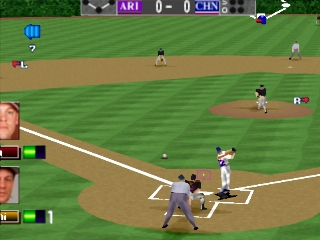
The batting cursor shows the area in which you can hit the ball. The size of the cursor is determined by a batter's contact ability, based on real-life performance ratings.
After the pitcher throws the ball, an indicator (O) comes up to show the ball's location. To hit the ball on the sweet spot, line up the cursor's "X" and the ball's "O" and press the "swing" button at the precise moment.
Hitting the ball off the sweet spot will result in a less solid hit. For example, if you hit the ball with the "O" above the cursor, the ball is popped up. If you hit the ball with the "O" below the cursor, you'll hit a ground ball. The timing of the hit also affects where the ball will travel.
There are 2 types of swings: contact swing (default) and power swing. You can change these types by pressing the L1 or L2 button. A power swing reduces the batting cursor size, making it harder to hit, but the ball will travel faster and further.
If the batter is a switch hitter, you can choose to bat left- or right-handed, regardless of the pitcher's throwing arm. You can switch when you call time.
Pitching
First, press the Directional buttons to choose the type of pitch you want to throw. If you select a pitch the pitcher can't throw, he will shake you off. If you don't press any direction, the pitcher will throw a change-up.
After you select a pitch, press the X button to start pitching. While the pitcher is in his pitching motion, use the Directional buttons to move the catcher's mitt to where you want to throw. After the pitcher releases the ball, you can't change the location. The break of the pitch is determined by the type of pitch selected.
Fielding
The fielder you control is the one with the mark above him. Other fielders move independently. Any outfielder who is off screen is marked at the edge of the screen with the letter R (right fielder), C (center fielder) or L (left fielder).
Defense
While pitching, you can adjust your defense by pressing the L1, L2, or R2 button.
Choose from four options:
•
DEF. IN to bring the defense in toward the batter
•
DEF. OUT to prepare for the big sluggers
•
CORNERS IN if you anticipate a bunt.
Soft Reset
Hold down the SELECT and START buttons for 2 seconds to reset the game. You will be returned to the title sequence.
Press the START button to call a time out. Select "QUIT" and press the button, then select Yes and press the button to execute.
Knowing Your Team
Throughout the game, you will be dealing with players on one or more teams. This section will help you get to know your team.
Rosters
Players are color coded for easier recognition:
•
Half yellow/green = Utility fielder
About Fielders
•
RUN means how fast the player can run.
•
ARM means how far the player can throw a ball.
•
The rating A is best and E is poor.
•
[X] indicates that player's batting cursor.
•
The rating A is largest (best) and E is smallest (poor).
Biorhythm
•
BIO indicates the physical status of a player. The more green, the greater his vitality. Solid green means he's at the top of his game and empty means he's in a slump.
•
Pitchers gauge shows the pitchers' pitching ability.
•
The five directional arrows show what kind of pitches that pitcher can throw, and the fullness of the arrows indicates how much the pitch will break.
•
In the center of the gauge is the maximum speed that the pitcher can throw.
To change the order, move the cursor to the name of the player you want to replace, press the X button to highlight that player (or the O button to cancel). Move the cursor to the name of the new player and press the X button again to swap them.
Fatigue Factors
If your pitcher is getting tired after a lot of pitching, his chances of throwing a wild pitch increase. If the pitcher appears to be breathing heavily on the mound, he's probably ready to come out of the game.
Also, if a pitcher gives up a lot of hits or home runs, he will get flustered. You can tell by looking at the health barometer, the green bar, beside his name plate. If it is blinking, then your man is getting "rock